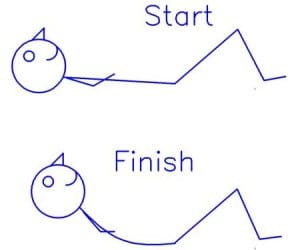
 “No more boring crunches!” It might sound like an infomercial on late-night TV, but it’s true: crunches and sit-ups don’t do much for the runner. Sit-ups and leg raises can potentially overwork one of the deep hip flexor muscles and they also place high compressive loads on the lumbar spine. These exercises don’t just train the core ineffectively; they may also damage the back at the same time. Traditional exercise programs have always incorporated trunk flexion (sit-ups) and extension exercises, while ignoring lumbar stability.
Also known as core stability, lumbar stability is the ability to resist unwanted or unnecessary motion in the trunk and hip regions. To a runner, this means upper- and lower-body running economy. When running, your core muscles are driven by reflex behaviour, but it can be altered by poor articleure, lack of mobility and flexibility, improper movement patterns, muscle strength imbalances or an insufficient warmup. A lack of core stability can cause head-bobbing, rounded shoulders, excessive arm swing and increased lumbar lordosis – inward rounding of the lower spine. Improving your core stability will improve your running economy and thus boost running performance. Core training can also:
- – Reduce your risk of injury and contribute to achieving optimal lumbo-pelvic alignment
- – Improve your sense of balance
- – Lead to greater power generation
- – Stabilize the torques created by the swinging arms and propelling legs, termed “dynamic stability”
Anti-rotation exercises
Cue anti-rotation training – also known as core conditioning, lumbo-pelvic stability training, core training or ab work. Runners need to think about the function of the abdominal muscles when deciding what core exercises to perform. Functional abdominal exercises should stabilize the spine and maintain lumbo-pelvic alignment. Think control rather than quantity. Control is the most important aspect of stability training and it is related to muscle recruitment patterns, timing and muscular endurance. Learning how to brace with a neutral spine will help you maintain the correct anatomical alignment of the lumbar spine because of the shape of the vertebrae and discs.
A neutral spine
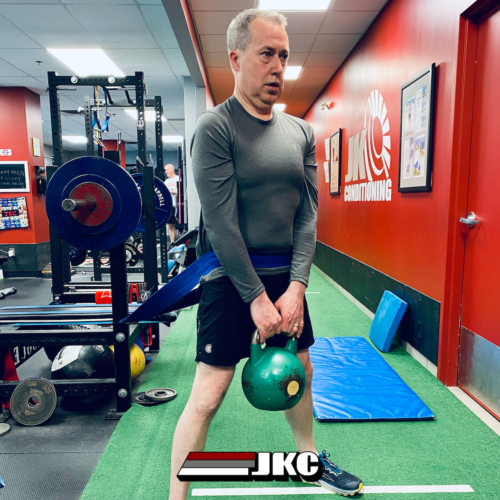
Bracing the abdominal wall involves tightening all the abdominal muscles surrounding the torso to create 360 degrees of stiffness. Only a slight contraction is necessary to protect and stabilize the lumbar spine and you should be able to breathe while maintaining the brace. Picture attempting to prepare the torso to receive a punch – your abdominal wall does not hollow in or push out, rather the muscles just contract to form a stiff wall around your waist. Keep in mind the abdominal muscles are just a component to full body stability, running performance and health. Appropriate hip and upper back mobility training is important, as is gluteal strength. When strength training, such as performing squats, lunges or other single leg exercises, you should be “braced” to protect your lumbar spine. The exercises do not have to be ab-dominant to train your core.
Stand your ground
Many runners believe that training on unstable surfaces such as Swiss balls or Bosu balls challenges their core and helps improve running performance. In reality, performing exercises on unstable surfaces has been shown to offer no improvement in running economy, articleure or performance. Doing lunges onto a Bosu ball actually impedes strength gains, since it lowers the force output.
To read the rest of the article, please go to Canadian Running HERE.