

By Julia Howard, MPH, RHN
Man, I love lentils.
And, they’re just so darn good for you.
But, like many Newfoundlanders, I didn’t really grow up eating lentils. I ate the classic legumes for Newfoundland local culture which, for my family, included red kidney beans in chillies, yellow split peas in pea soup, and maple-flavoured breakfast beans. That’s about it.
However, lentils (and pulses, in general) are so diverse. Soups, stews, curries, salads, and even lentil loafs (hey, don’t knock it til you’ve tried it).
The health benefits of lentils come, in part, due to their high fibre content, both soluble and insoluble fibre. They’re also high in complex carbohydrates, slowly digestible starch and resistant starch.
Lentils and “The Second Meal Effect”
Lentils (and pulses) can help lower blood sugar levels and hormonal responses to starchy foods as well as help decrease blood lipids.
And, get this… Research has found that lentils produce something called “the second meal effect” which means they produce positive effects on blood sugar levels hours after eating them. In fact, lentils may even help keep blood sugar levels lower after eating a second meal of a more easily digestible carbohydrate, such as a piece of white bread! Hence the term, the second meal effect. (Mollard et al, 2014; Higgins, 2012; Li et al, 2014).
Lentils may also help suppress appetite.
If you’re thinking, ok cool, but why though… Congrats. You’re a nerd like me.
Gut Microbiome to the Rescue
Not only does your digestive system take more time to digest lentils due to their fibre and starchy carb content (leading to a lower initial blood sugar surge) but, the activities of your gut microbiome may also play a role in lowering blood sugar levels over the longer term, even 4 to 12 hours later. (Higgins, 2012).
Research points to the fermentation of indigestible carbohydrates in the gut following the consumption of lentils, which produces compounds called short-chain fatty acids. (Higgins, 2012).
Short-chain fatty acids produced by the fermentation of indigestible carbohydrates are associated with improved insulin sensitivity and glucose tolerance due to decreased liver glucose production and free fatty acid levels.
The second meal effect can also be found in studies of other legumes, such as chickpeas and brown beans, as well as in studies of whole, unprocessed/unmilled grains. In another study by Nilsson et al (2013), compared with white bread, “the consumption of brown beans in the evening led to lower hunger ratings and lower blood sugar and increased plasma short chain fatty acids after breakfast the following day”, which, according to the authors of this study, was likely also in response to the indigestible carbohydrates in the beans.
Gut microbiome to the rescue. Just picture that the next time you eat lentils or beans!
Digesting Lentils
And yep, lentils may cause some bloating and flatulence if you’re not used to eating them but, with gradual introduction over time, you may be able to include more of them in your diet with less dramatic effects. You really do need to give your gut environment some time to adapt.
Also, make sure you’ve cooked them thoroughly to prevent unnecessary digestive discomfort. The addition of spices like coriander and cumin (called carminatives) may also help reduce excess gas production following the consumption of lentils and other legumes. Check out the following recipe to see what I mean.
Lentil Alphabet Soup
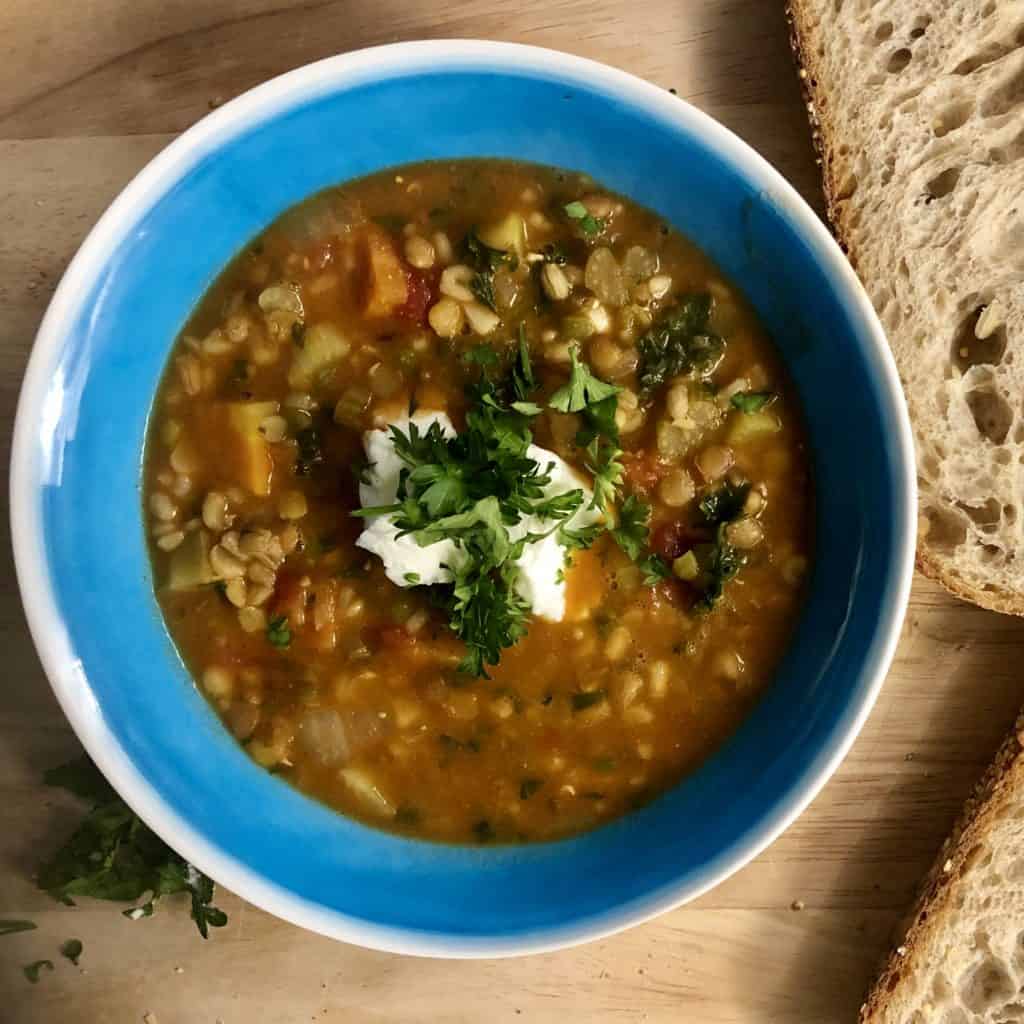
This Lentil Alphabet Soup calls for Bob’s Red Mill Vegi Soup Mix, which is a mixture of green split peas, yellow split peas, barley, brown lentils, and mini alphabet-shaped pastas. I like to serve this soup with some slices of sourdough bread and garnished with parsley and greek yogurt on top.
Note: Due to the presence of barley and wheat pasta in this soup mix, it is not gluten-free. Also, you may find that you need to add more water to your version of this soup. I prefer to make my soups less watery, more like a stew.
Ingredients
- 3 tbsp olive oil
- 1 white onion, decided
- 4 large carrots (I used a mix of orange and yellow)
- 4 sticks celery
- 1 tsp coriander seeds
- 1 tsp ground cumin
- 1 tsp ground coriander
- 1 tsp chili powder
- pinch sea salt
- 10 cups water (plus more if needed)
- 1 large can diced tomatoes with juices
- 1 lemon, juiced
- 1 bunch parsley
- 3 cups Bob’s Red Mill Vegi Soup Mix
Directions
- In a large soup pot, add 2 tbsp extra virgin olive oil, 1 white onion (diced), 4 large carrots (chopped), and 4 sticks celery (chopped).
- Sauté veggies on medium high heat.
- Next add 1 teaspoon coriander seeds, 1 teaspoon ground cumin, 1 teaspoon ground coriander, 1 teaspoon chili powder, 1 tbsp olive oil, and a pinch of sea salt.
- Sauté ingredients on medium high heat.
- Next add 4 cups of water, 1 large can diced tomatoes and bring veggies to simmer
- Next add, 3 cups of Bob’s Red Mill Vegi Soup Mix and another 6 cups water
- Cover pot and simmer for 15-20 minutes until lentils softened
- Turn heat to low and add 1-2 cups parsley (chopped), juice of 1 lemon and let flavours blend for 5-10 minutes.
- Serve in bowls garnished with plain Greek yogurt and parsley.
Enjoy!
If you’re interested in learning more about nutrition or need help reaching your nutrition goals, get in touch!

Sources
Higgins, J.A. (2012). Whole grains, legumes, and the subsequent meal effect: implications for blood glucose control and the role of fermentation. J. Nutr. Metab. 2012: 829238. doi:10.1155/2012/829238.
Li SS, Kendall CW, de Souza RJ, Jayalath VH, Cozma AI, Ha V, Mirrahimi A, Chiavaroli L, Augustin LS, Blanco Mejia S, Leiter LA, Beyene J, Jenkins DJ, Sievenpiper JL.(2014). Dietary pulses, satiety and food intake: a systematic review and meta-analysis of acute feeding trials. Obesity (Silver Spring). 2014 Aug;22(8):1773-80. doi: 10.1002/oby.20782.
McCrory, M.A., Hamaker, B.R., Lovejoy, J.C., and Eichelsdoerfer, P.E. (2010). Pulse consumption, satiety, and weight management. Adv. Nutr. 1(1): 17–30. doi:10. 3945/an.110.1006.
Mollard, Rebecca C. ; Wong, Christina L. ; Luhovyy, Bohdan L. ; Cho, France ; Anderson, G. Harvey. (2014). First and second meal effects of pulses on blood glucose, appetite, and food intake at a later meal. Applied Physiology, Nutrition, and Metabolism, 2014, Vol.39(7), pp.849-851
Mollard, Rebecca C.; Wong, Christina L.; Luhovyy, Bohdan L.; Anderson, G. Harvey. (2011). Second-meal effects of pulses on blood glucose and subjective appetite following a standardized meal 2 h later. Applied Physiology, Nutrition, and Metabolism, 2011, Vol.36(5), pp.634-642
Nilsson, A., Johansson, E., Ekström, L., and Björck, I. 2013. Effects of a brown beans evening meal on metabolic risk markers and appetite regulating hor- mones at a subsequent standardized breakfast: a randomized cross-over study. PLoS ONE, 8(4): e59985. doi:10.1371/journal.pone.0059985.