Here’s a post I started a while ago but failed to get it up on JKConditioning.com until now. It’s dedicated to current and future firefighters (FF) AKA Tactical Athletes, but also to personal trainers and strength coaches who train or want to train FFs. (Also, it’s written very informally)
The occupational demands of firefighting place FFs at higher than average risk for cardiovascular events and ergonomic related disorders. Among the top ways to get injured while working include musculoskeletal strains and overexertion.
Some goals of training FFs:
- Improve VO2max and Lactate Threshold
- Reduce perception of fatigue
- Improve flexibility and mobility
- Prevent injury and mortality risk
- Improve overall strength and ability to move with gear on
Physically very demanding job with minimal notice – whether it’s the middle of the day or at 3:49AM when the FF is sound asleep. The FF has to be ready at any time so there isn’t too much the FF can do aside from being in peak physical condition – this will at least lower injury risk because the tissue tolerance to stress will be heightened (relative to a FF who’s not fit).
Firefighting requires strength, stamina, good conditioning, cardiovascular endurance, dynamic flexibility with functional stability, muscular endurance, mental toughness, the ability to recover between tasks, tolerance to heat and turnout gear, SCBA pack weight, grip strength –strong muscles, a strong heart, and sustained power. Basically, all athletic qualities should be developed – just like GSP.
Need to be able to function with minimal rest and sometimes sleep deprivation.
Firefighting contains any one of these tasks: suitcase carries, overhead carries, over the shoulder carries, back pack carry (SCBA), climbing (ladders), crawling, deep squatting, deep squatting to pick-up (dummy drag), overhead work (pike pole), carry charged hose lines, forcible entry, carry and use heavy equipment (jaws and cutters), carrying and putting up extension ladders and hauling up equipment with ropes.
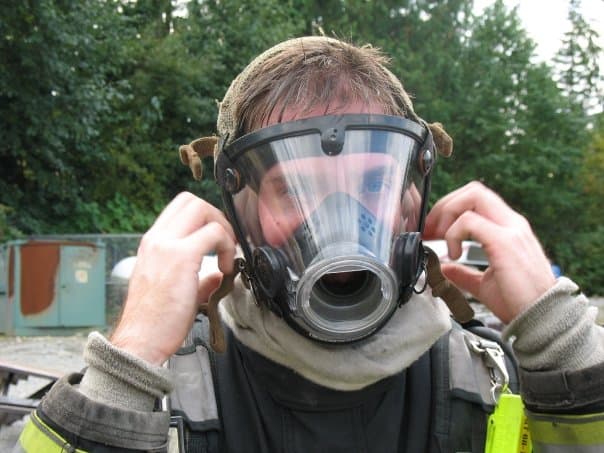
The turn-out gear, helmet, SCBA, boots, among other items worn while firefighting can easily weigh over 65 lbs – climbing ladders or stairs with all that gear is a workout in itself!
Incorporate different conditioning tools in your workout:
- Sand bags
- Keg
- Battling Ropes
- Kettlebells
- Sleds and Prowlers
- Car Pushing
- Jump Rope
- Stair Climbers
- Air Dynes
- Concept II Rowers
- Weight Vest Circuits
- Tire Flipping
- Playground Equipment (monkey bars, parallel bars, swing sets, etc.)
- Hill Sprints
- Medicine Balls
- Sledgehammers
- Rings, Blast Straps, TRX Systems
- Bands
- Bucket of Rice for grip training
When designing a program, focus on functional lifts (dead lifts, variations of squats and single leg work, vertical pulling (variations of pull ups and chin ups), vertical pressing (variations of overhead pressing, kettlebell shoulder exercises e.g. Turkish get-ups, windmills, overhead walks), horizontal pulling (dumbbell rows, rope rowing), horizontal pressing (bench press, ring pushups, weighted pushups), core (single arm farmer’s carry, Turkish get ups, get-up sit-ups, bear crawls, power wheel, renegade rows)…save the machines and isolation exercises for the body builders. No 3 sets of 10 on the pec deck with a 303 tempo is going to give you the conditioning and strength required. No 30 minutes cardio, 50 minutes machine weights followed by another 30 minutes are cardio.
Kettlebells train the body as a whole. It’s a versatile tool that doesn’t require a crazy amount of space like other tradition gym equipment. It’s portable – you can take it to the park, the fire hall, your friend’s house – wherever. It’s easy to crate complexes with kettlebells – a series of exercises performed without putting the kettlebell down.
Here’s one I like to use:
- 6 double kettlebell snatches to overhead squats
- 6 double cleans to front squats
- double overhead kettlebell walks (waiter’s carry) for distance
- 6 double kettlebell swings
- 6 alternating bent over kettlebell rows
- 6 kettlebell pushups
Perform 3-5 sets and take 60-90 seconds between sets. Sure beats boring cardio machines! But if you like that kind of thing – to each their own!
Aim for 30-45 minute workouts, short breaks and high intensities.
To improve conditioning, use timed sets and circuit training…use the Tabata protocol, use pyramids, use complexes…use EDT by Charles Staley. The step mill (NOT stair master) and treadmill sprints are traditional cardio machines you can use. Prowler sprints, sled sprints and car pushing also make for great conditioning sessions. Don’t bother with hours on the elliptical or recumbent bike – they are far less effective at delivering the results you’re looking for.
I like the idea of Crossfit being used for the emergency services, but I don’t agree with the idea of using Olympic lifts for timed sets – the technique goes out the window and the risk for injury rises exponentially. I like how Crossfit utilizes functional movements among other exercises to develop strength, power, speed and agility though. Remember, Crossfit is a program or training style and not an end-all-be-all solution to fitness.
I’m not against slow cardio for FFs – as some people in this industry hate long slow cardio workouts. I think easy runs or easy air dyne bike rides are necessary for recovery as they promote cardiovascular adaptations and they don’t tax the nervous system like heavy sled pushing or intense running workouts e.g. quarter mile repeats. Aim for 65% of your max heart rate and take it easy – 20-45 minutes should be sufficient.
Don’t forget to train for strength! I like developing strength in all planes of movement – whether if it’s doing chin ups for 8 sets of 3 with the heaviest weight possible, deadlifting heavy for 5 sets of 5 or doing cluster sets of 3 while squatting ass to grass.
Practice mobility work in your warm up AKA the dynamic warm up. Certain joints like to be mobile and others like to be stable – train them that way! Train stability in your lumbar spine and scapulae – train mobility at your ankle, hips, thoracic spine and shoulders.
Don’t train to failure, recover harder than you train, have naps, eat well and hydrate…foam roll your muscles while watching TV.
Here’s how you can structure a typical workout:
- Self Myofascial Release – foam rolling, tennis ball trigger pointing etc.
- Dynamic stretches to promote mobility
- Muscle Activation e.g. glute bridges or scapular pushups etc.
- Power/Strength Exercises e.g. power cleans, heavy pull ups etc.
- Conditioning circuits e.g. the kettlebell circuit described above **include core exercises here
- Cool down with more self myofascial release or static stretching AND focus on NUTRITION!
I hope that gives you some insight into how a FF can train. The key is remembering that injury prevention and cardiovascular development are of prime importance! Remember to always seek medical clearance when starting an exercise program.
Thanks for reading,
-JK