
By Thomas King, MSc, CSCS, CSEP-CEP
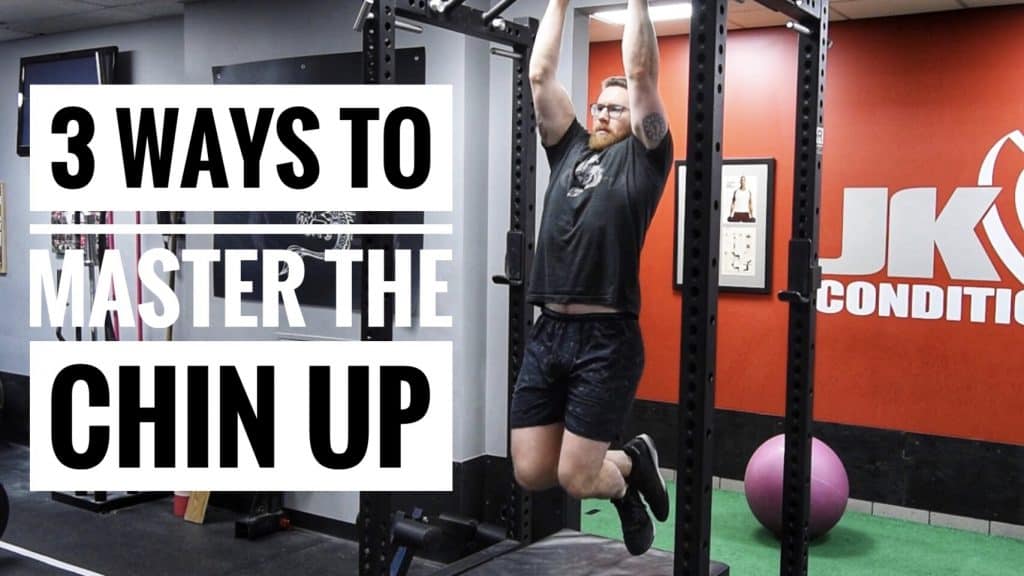
The chin-up is considered by many to be the true gold standard of fitness. Unlike exercises such as the bench press or deadlift, in which you move an external weight, the chin-up forces you to lift your own bodyweight, giving a true indication of your relative strength.
Despite this, the average gym goer does not frequently use the chin-up as a training tool. Because chin-ups are difficult, lat pull downs are the more favourable option. This is unfortunate since the chin-up is undoubtedly one of the best exercises for strengthening the lats, biceps, forearms, shoulder stabilizers and grip.
In fact, the name chin-up itself is a bit of a misnomer as the goal of a properly executed chin-up is to bring the collarbone to the bar, not just the chin.
The Ideal Chin-Up Technique
- -Dead-hang from the chin-up bar with your preferred grip. Pack your shoulders and brace your abs to prevent your low back from going into excessive extension.
- -Initiate the pull by focusing on bringing your elbows down to your rib cage. This will help activate your lats.
- -Pull yourself upwards until your collarbone makes contact with the bar. Make sure that your chin is tucked at the top of the movement. Don’t hyperextend your neck by looking up.
- -Hold the top position for about one second keeping your shoulders away from your ears. Keep your abs engaged and try not to swing.
- -Slowly lower to the bottom position and repeat for the desired number of repetitions.
Grip Variations
- -Double underhand grip = “Chin-up“
- -Double overhand grip = “Pull up“
- -Neutral grip (palms facing together) = “Neutral grip chin-up“
- -Mixed grip (using a different grip for each hand) = “Mixed grip chin-up“
If you can’t perform a full range chin-up, try adding in these 3 chin-up variations to your workouts. You will build strength for different phases of the chin-up and finally reach that milestone of one perfect chin-up.
1) Improve the Bottom Range: The Banded Chin-Up
These are great if you struggle with the bottom range on the chin-up. To do this variation, attach one end of a long band to the chin-up bar. Next, pull the band down and place it either around your foot (easier/more help) or around your knee (harder/less band help). Follow the above technique guidelines and preform the desired number of reps.
2) Improve the Top Range: The Rack Chin-Up
Next, we’ll tackle the opposite issue. If you struggle with the top range of the chin-up movement, this is the best variation for you. Place a barbell in an adjustable power rack at a height where your arms are fully outstretched and you butt just touches the floor. Your feet can either sit flat on the floor in front of you (very deep squat) or the legs can be crossed in front of you. Initiate the pull by bringing your elbows to your rib cage. Use your legs sparingly to assist you in achieving the full range of motion for the exercise. Repeat for desired number of repetitions.
3) Train the Descent: The Negative Chin-Up
Due to the physiological processes that occur when a muscle is contracted, we are much stronger lowering (eccentric contraction) a weight (or our body) than we are at lifting (concentric contraction) a weight. In addition, our muscles get stronger not just by lifting, but by lowering weights as well. Because of this, the negative chin-up is an excellent variation to strengthen the muscles involved in a chin-up.
Stand on a tall box underneath a chin-up bar. Grab the bar and jump up to reach the top position. Try not to swing. Hold this position steady for 3-5 seconds, then slowly lower your body over a 8-10 second count. Once your elbows and shoulders open fully, stand back on the box, and jump up for your next repetition. Repeat for desired number of repetitions.
Sample Weekly Routine
While it may seem like an unattainable goal when you first start your fitness journey, doing one perfect chin-up is within reach for anyone with the proper coaching and motivation. Using the above chin-up variations should help you reach your goal sooner than you might think! Here is a sample training-week that incorporates the techniques listed above.
Monday – Band Assisted Chin-Up – 5 sets of 5 reps with the band around your feet
Wednesday – Rack Assisted Chin-Up – 8 sets of 3 reps
Saturday – Negative Chin-Up – 3 sets of 5 reps with a 5-10-second lowering phase